
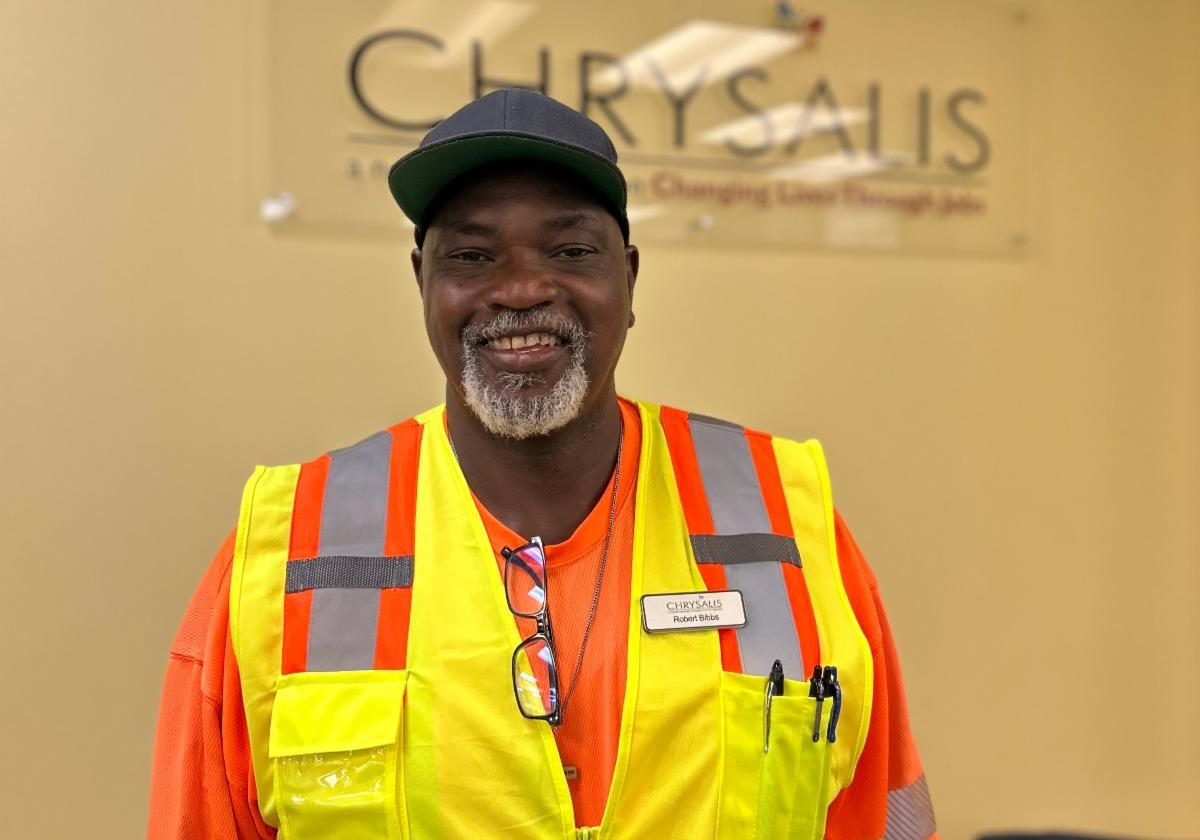
Before he found a new path with Back 2 Work, Robert Bibbs spent most of his life trapped in a vicious cycle—poor decisions, prison time, and an inability to escape the path that seemed to define him.
He was no stranger to the inside of a prison cell, with multiple incarcerations. Each time, he left with the hope of staying out for good, but the same destructive patterns always brought him back.
“I was pretty rough around the edges, and I made some horrible decisions,” he said. “I didn’t care much about what people thought of me, and I didn’t think about them.”
But when he found himself behind bars for the fifth time, something inside him began to change.
“I finally had to confront that man in the mirror. I asked him, ‘What are you doing back here? Is this what you really want?’”
It was a moment of reckoning for Bibbs. He realized that unless he changed, he’d always return to the same place.
“I was tired of it. I was tired of being the guy who always ended up in the same spot because I couldn’t figure out how to break the cycle.”
The End of the Cycle – and the Start of a New One
His introspection became a turning point. Bibbs took responsibility for his life in a way he hadn’t before. He stopped pointing fingers at others and began to confront the reality of his situation. He stopped blaming a system conspiring to keep him down, and started blaming his own choices. Bibbs began some of the learning programs and classes available in prison, reconnected with his faith, and developed a new sense of self-worth.
“I had to look at me,” he admitted. “I realized that I was the common denominator in all my problems. It wasn’t everyone else—it was me.”
When he left prison for the last time, Bibbs made a promise to himself that things would be different. But despite his newfound perspective, re-entering society was far from easy. Like many formerly incarcerated individuals, he struggled to find work. With each job rejection, the familiar weight of hopelessness crept back in.
“Nobody wanted to hire me,” he said. “No matter how much I had changed, people only saw my past.”
Back 2 Work and Chrysalis
That’s when a friend told him about Chrysalis, a nonprofit organization in Southern California dedicated to helping individuals find jobs and reintegrate into society. Chrysalis connected him with BCOE‘s Back 2 Work program, a transitional employment initiative designed to help people like him not only find jobs but also rebuild their lives. It wasn’t just about employment—it was about creating a foundation for stability, purpose, and self-worth.
The Back 2 Work program works by partnering with local governments and organizations, like Chrysalis, to create paid transitional jobs that help people like Bibbs gain work experience while also addressing their barriers to long-term employment. Participants work on projects like road maintenance, cleaning public spaces, and landscape work, tasks that allow them to develop critical job skills while receiving the support they need to overcome personal challenges, like substance abuse, trauma, or housing instability.
From the moment Bibbs walked through the doors of Chrysalis, things started to shift.
“Back 2 Work gave me a second chance,” he said. “They didn’t care about my past—they cared about who I wanted to become. It showed me that I matter. Back 2 Work was, for me, an opportunity to enter back into society and do some things I never thought I would do.”
‘Now I’m in the Front’
For the first time in a long time, others started to see potential in Bibbs that went beyond his criminal record. Bibbs began as a crew member, working on the streets of downtown Los Angeles and grateful just to have a job. For months, he showed up every day, eager to prove himself. But the real change came when his supervisor, Scott Zurich, pulled him aside and told him something that took him completely by surprise.
“Scott saw something in me that I didn’t see in myself,” Bibbs recalled. “He said, ‘You’re already a leader. You just don’t know it yet.’”
For a man who had spent much of his life feeling invisible, hearing that was a revelation.
“I didn’t believe him at first. How could I be a leader? I’d spent my whole life messing up.”
But Zurich’s belief in him sparked something, and soon enough, Bibbs began taking on more responsibility. Within months, he earned a promotion to crew supervisor, a role he has held for over a year now.
“I started in the back of the van, and now I’m in the front,” he said with a smile. “And I tell my guys, if I can do it, so can you.”
Embracing Leadership
As a supervisor, Bibbs now leads a crew of 38 men, many of whom are navigating the same struggles he once faced. His leadership is deeply personal; he knows what it’s like to feel stuck in a seemingly unbreakable cycle. Every day, he leads his team through what he calls the “Big Seven,” a list of core values that guide their work: respect, integrity, empowerment, empathy, self-discipline, self-control, and self-esteem. These aren’t just buzzwords for Bibbs—they’re principles that helped him turn his life around.
One of Bibbs’ greatest strengths as a leader is his ability to connect with his crew on a human level. He sees them not as clients or workers, but as individuals with stories, potential, and worth.
“These men have been through a lot,” he said. “But they matter. And I make sure they know that I care about them, not just as workers, but as people.”
His leadership hasn’t gone unnoticed. Angelica Oropeza, Back 2 Work’s Operations Coordinator who has worked closely with Bibbs, spoke highly of his impact on the crew.
“Robert has this amazing energy about him—he’s always positive, always looking out for his crew,” Oropeza said. “The way he interacts with his team is inspiring. He’s not just their supervisor; he’s their mentor. He’s teaching them that they have value, that they can be leaders too.”
A New Path

This cycle of empowerment—of believing in others the way Zurich believed in Bibbs—has become central to Bibbs’ approach. It’s a powerful reversal of the cycle that once controlled his life.
His two sisters, Cassandra and Tina, have been his biggest supporters throughout this journey. After years of watching their brother struggle, they are now overjoyed at the man he’s become. The relationship with his sisters is the one Bibbs said means the most to him.
“They’re so proud of me,” Bibbs said with a smile. “And for the first time in a long time, I feel like I’m on a great path.”

The Back 2 Work program, much like Bibbs himself, is about breaking cycles. It’s about giving people the tools, the support, and the belief they need to start new, positive cycles—ones built on stability, purpose, and dignity. Bibbs is not only an example of what’s possible when someone gets a second chance; he’s proof that with the right guidance, anyone can rewrite their story.
As Bibbs looks toward the future, he’s not just focused on his own success but on the success of the men he leads. “I tell them every day,” he said. “You matter, and you can do better. Just like I did.”
You must be logged in to post a comment.