
On the first day of school, Elizabeth Bertrams’ students had a question.
“When do we get robots?”
The year before, Bertrams had started borrowing equipment from the Butte County Office of Education’s EdTech Exchange. She was unfamiliar with the technology but ready to try it with her students at Paradise Children’s Community Charter School. By the time they returned for a new school year, they were ready for more.
Their anticipation offers one measure of a program now earning statewide recognition. BCOE’s EdTech Exchange has received a 2026 Golden Bell Award from the California School Boards Association (CSBA) in the Technology Innovation category. The award honors BCOE’s work to expand access to educational technology and help educators bring it into their classrooms.
About the Golden Bell Awards
The Golden Bell Awards recognize outstanding programs and school board governance practices, with an emphasis on demonstrated benefits for students, sustainability and approaches other schools can replicate. BCOE will receive recognition at the awards ceremony Dec. 3 in San Diego. The EdTech team, led by Tracey Allen, BCOE’s Senior Director of Professional Learning, includes coaches Anna Brink Capriola, Jake Carr, Janet Brownell, and Laurie York, as well as district/school support specialist Carrie Heyrend.
Designed to address the challenges of rural schools, the Exchange combines a countywide technology lending library with personalized coaching and professional learning. It serves more than 435 educators across 28 districts and local charter schools and has facilitated more than 2,100 checkouts.
“The biggest thing to me is how it allows teachers to have an impact on so many students. It’s synergistic–if a teacher is utilizing it in their own classrooms, they share that with their colleagues, and soon everybody has an interest,” said Mary Sakuma, Butte County Superintendent of Schools. “We have teachers who have borrowed items from the EdTech Exchange to use in their own classrooms, and then they’ve come back and asked if they can help with the next event and show to other teachers how they used it in their own classroom.
“To me, that’s just priceless, because we take a lot of pride in supporting the excellence of every educator.”
Across local classrooms, those discoveries take many forms. Teachers describe students building imaginary cities, working through coding problems and finding interests strong enough to inspire new robotics clubs. They also describe changes in their own teaching—and the confidence they get when someone helps them get started.
Learning alongside their students
At Little Chico Creek Elementary School, second grade teacher Andi Lougee borrowed Blue-Bot robots to help teach students about pollination, flower parts and describing flowers. Students also programmed the robots to travel along streets on maps, working to avoid the businesses along their routes.
Soon, they were making maps of their own out of bulletin paper and inviting friends to navigate their towns.
With borrowed iPads and programmable train sets, Lougee introduced another kind of coding. Students experimented with tracks and instructions, using trial and error to make trains behave differently at different points along a route. One group built a city and imagined its train as a superhero, stopping to help at places around town.
“This is something that I never thought I could do,” Lougee said, “let alone teach second graders to do.”
Some students were so absorbed that they did not want to leave for recess. When she brought the trains to a school science night, the station became the busiest of the evening. For Lougee, access to the equipment was only part of what made those lessons possible. The Exchange also helped her learn how to use it.
“I would never have been able to afford, let alone have the confidence to teach my class about these science topics,” she said.
Her experience illustrates the close connection between equipment and support. A teacher can borrow a tool, learn how it works, try a lesson and return with ideas for the next one. Students get room to experiment, and their teachers do, too.

When interest becomes opportunity
At Parkview Elementary School in Chico, first grade teacher Emily Lamb saw that experimentation lead to a larger commitment. Thanks to EdTech Exchange, she has started two robotics clubs at her school because she has seen the passion that students have for technology. She credits the program with helping her teach perseverance and problem-solving. The equipment gave students challenges to work through—and gave her a way to see how much they wanted to keep learning.
At Wilson Elementary School, science teacher Dennis Jackson describes a similar connection between classroom access and opportunities for the wider school community.
“Our school’s Family STEM night would not be possible without the support of the technology exchange,” Jackson said.
He points to practical details that make participation manageable: a straightforward reservation process, instructions that help teachers get started when they open a box, and staff members who bring ideas to conversations about lessons.
Bertrams, who teaches PE and science to TK–5 students, also describes staff support as central to her experience. As she learned to reserve equipment, the team helped sort through her requests and make sure she received what she needed. For the new school year, she reserved equipment for three sessions with her students.
Their first-day question already told her something about what those sessions meant to them.
Preparing the next classroom
The Exchange’s work also reaches educators who have yet to lead classrooms of their own.
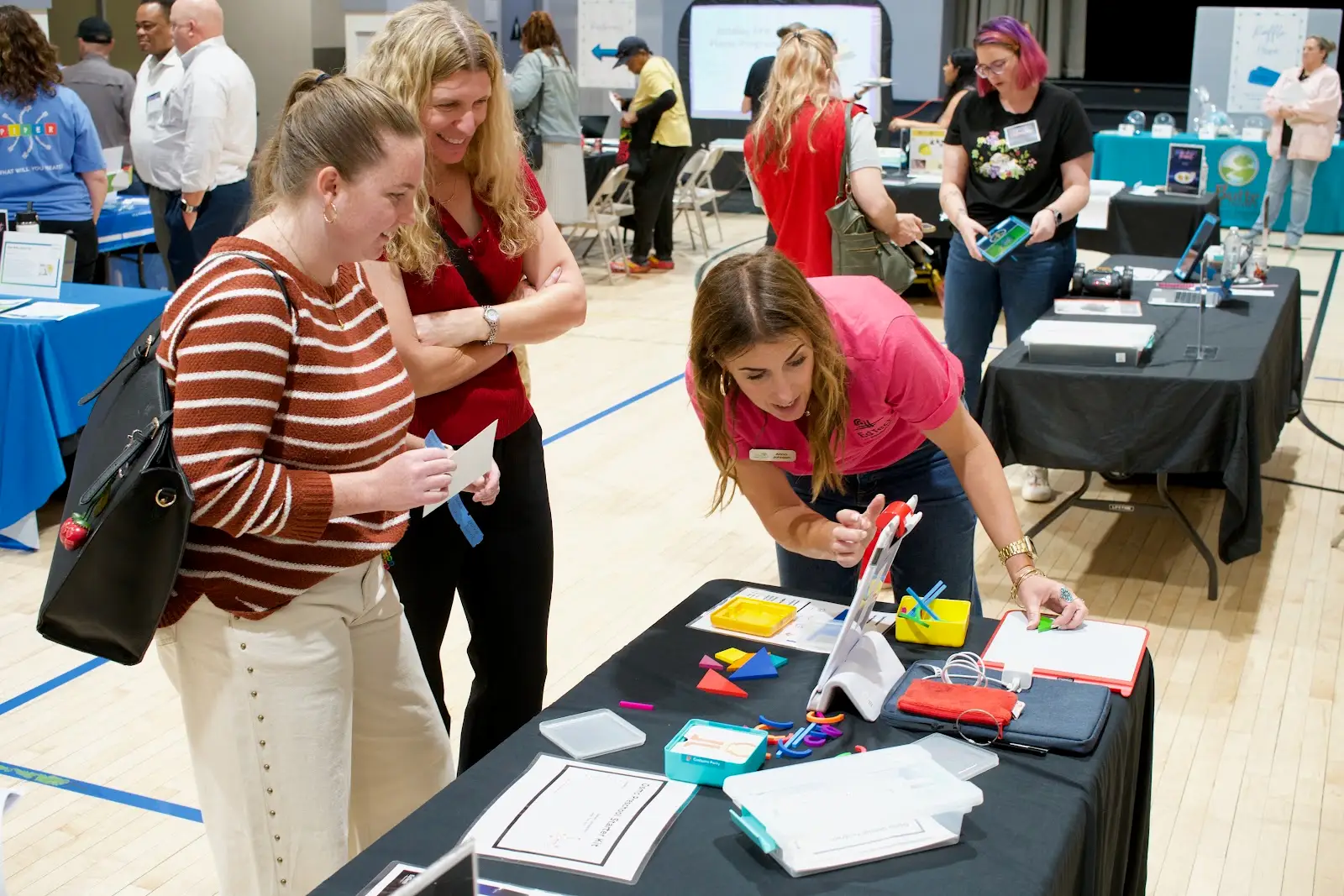
Through a partnership with Chico State’s teacher preparation programs, BCOE’s Educational Technology team hosted an Instructional Technology Showcase for future special educators. Teacher candidates explored equipment, asked questions and considered how different tools could support students with diverse learning needs.
The partnership continued through a longer-term course project in which candidates designed lessons incorporating instructional and assistive technologies. BCOE staff served as judges and offered feedback. According to Chico State’s Jamie Linn Gunderson, those lessons will become the first resources in a shared repository for other educators to use and adapt.
That same emphasis on building educators’ capacity matters across the North State. Jeff Salberg, BCOE’s Expanded Learning Services Region 2 Coordinator, supports programs across nine counties, where access to technology training and resources can be limited.
“For often under-resourced rural and frontier programs in Region 2, access to the training and resources provided through the Exchange is invaluable,” Salberg said.
He also describes a benefit that continues beyond a training session or equipment checkout: educators build connections with one another, creating a network for sharing ideas and continuing to learn.
“To me, the true measure of the EdTech Exchange is not the technology it provides, but the opportunities it creates,” Allen said. “Students and educators both can explore, create, and learn in meaningful ways.”
Leave a Reply
You must be logged in to post a comment.