
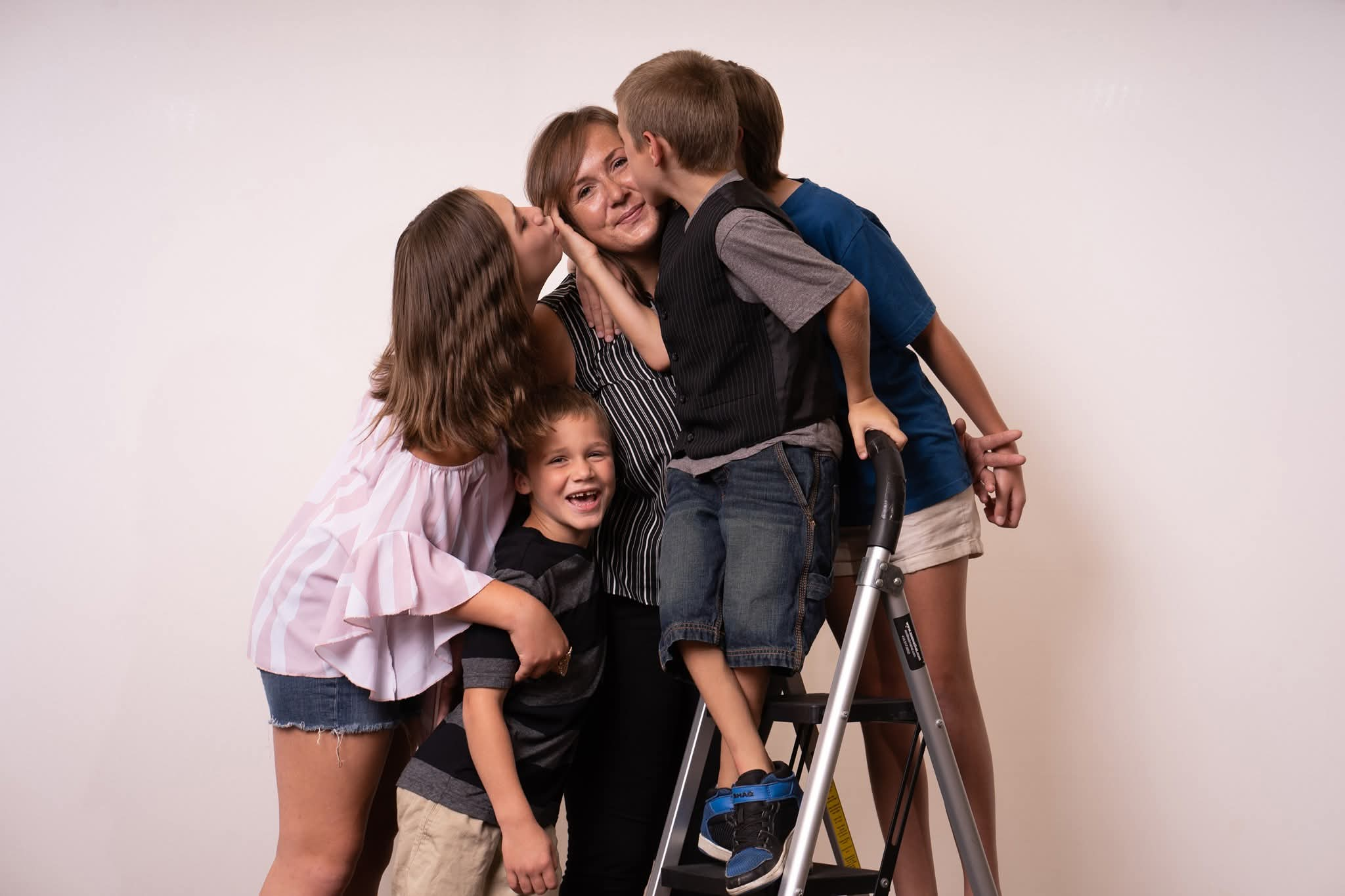
Families don’t arrive at Hearthstone School empty-handed.
Some bring with them new diagnoses. Some are carrying disrupted schooling. Others bear the burden of rebuilding after displacement, loss, or long stretches of instability. When those realities surface, Amber Paton is the person helping families figure out what comes next.
Paton is Hearthstone School’s parent liaison, a role centered on helping families access and navigate their child’s education. In practice, her work sits between systems and lived experience—helping schools understand families, and helping families understand what school can realistically offer.
“Every part of Amber’s being is about making a child’s success accessible to the parent,” said Principal Kelly Haight. “She enters every conversation from an ‘I’m here to serve you’ perspective.”
That approach is rooted in Paton’s own experience. She is the parent of four children, all with Individualized Education Programs, including two with autism and two with ADHD. She is also a Paradise Camp Fire survivor. The 2018 fire displaced her family, disrupted schooling, and dismantled routines that many children—and parents—depend on for stability.
Those experiences shape how Paton understands the families she works with.
“When my son was in first or second grade, he was undiagnosed at the time,” Paton said. “His autism showed up as behaviors at school. I was called to pick him up constantly. There was no conversation about what was really going on. I just felt like a bad parent.”
She carries that memory into her work.
“I don’t ever want a parent to feel the way I felt,” she said. “Education is here to serve students and families. That has to be the starting point.”
About Hearthstone School
Hearthstone’s mission is to foster academic and social-emotional development by empowering students to explore their own potential. Teachers and staff provide the path and tools that enable students to become agents of their own lifelong learning. To learn more, visit hearthstoneschool.net.
At Hearthstone, a BCOE charter school in Oroville, that starting point is rarely a preset solution. Paton spends much of her time listening, asking questions, and helping families articulate what is actually getting in the way. Frustration, anger, and hesitation are treated as information, not resistance.
“Parents can come in overwhelmed or defensive,” Haight said. “Amber doesn’t escalate that. She assumes there’s something difficult happening and responds from there.”
When plans stall, or systems don’t quite fit, Paton returns to a simple question: What can we do? Instead of focusing on what should have happened or what typically works, she wonders what is possible now. That question often carries her beyond her office.
Paton checks in on students who stop attending school. She follows up when families go quiet. She gives rides, buys alarm clocks, helps with laundry—whatever keeps a student connected long enough for progress to take hold.
“If we haven’t heard from them, we go check,” she said. “Not to enforce, but to care.”
Centering Parents in the Family
Paton’s work also shapes how families experience being together at school. Rather than separating parent education from student life, she helped redesign family events so parents and children participate side by side. Activities replace lectures, and conversations develop among families who realize they are not navigating these challenges alone.

“There’s something powerful about realizing you’re not the only one dealing with this,” Paton said. “That shared experience builds confidence.”
She is now extending that approach through a voluntary parent support group, intentionally light on structure and responsive to the needs of whoever attends. Bonding is the goal, she said, and it will develop as it goes.
That instinct reflects what Paton learned after the Camp Fire: recovery depends less on formal programs than on whether someone stays present when routines collapse and systems strain.
She brings that understanding into her work with students as well, often through service projects that emphasize shared responsibility and connection. Students regularly participate in small acts of giving—writing cards, organizing donations, working together in ways that reinforce belonging.
Haight sees Paton’s impact in the way families return and remain engaged. Paton does not describe her work in terms of initiatives or outcomes, but in terms of care: a follow-up call, a knock on a door, a parent walking back into the building after deciding not to disappear.
“She sees people,” Haight said. “She remembers their struggles and brings them together for solutions.”
At Hearthstone, the role of parent liaison is practical, relational, and essential. Paton’s work shows what becomes possible when support is built on understanding rather than assumption.
Travis Souders is the Communications Officer at the Butte County Office of Education.
You must be logged in to post a comment.